Green Aracari
Pteroglossus viridis

Species Specific Information
Habitat
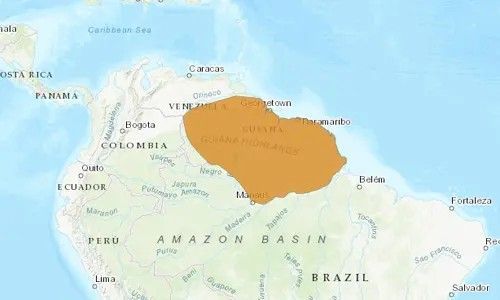
Terrestrial, tropical, forest, savanna, rainforest
Predators
Birds of prey, snakes, humans
Diet
Omnivore
Wild- Small birds, reptiles, eggs, insects, seeds, grains, nuts, fruit
Professional Care- Fruit, insects
Life Expectancy
Wild- 10 - 12 years
Professional Care- 15 - 18 years
Physical Characteristics:
Weight: 4 - 6 oz (100 - 160 g)
Size: 12 - 16 in (30 - 40 cm)
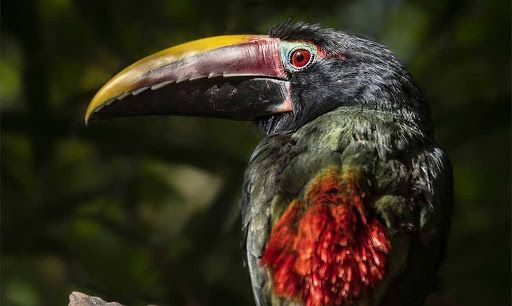
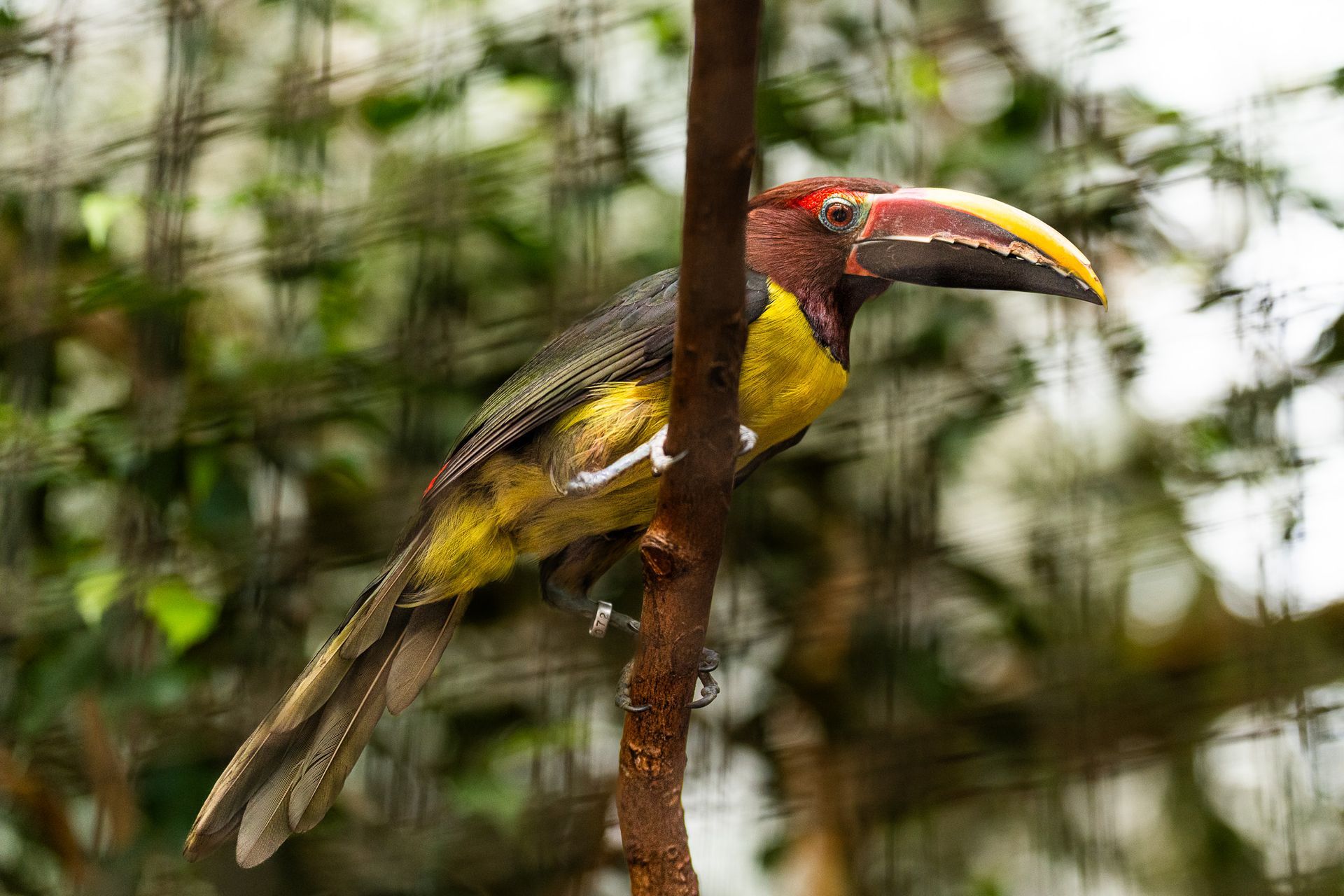
Distinguishing Characteristics: These colorful birds are among the smallest members of the toucan family. Green aracaris have dark green feathers on their backs, throughout their wings, and into their tails. They are sexually dichromatic birds, meaning males and females exhibit some differences in coloration. The male aracari's neck and head feathers are very dark, whereas the female aracari has dark red to brown coloration. These birds have a brightly colored red, yellow, and blue bill with a unique serrated edge; their bill is deliberately more hooked at the end than the bill of other aracaris.
Adaptations & Fun Facts:
Like all toucans, they are recognizable by their bright plumage and very large, colorful bills. They can be very active, often hopping from branch to branch with loud vocals. Their bill usually takes up around a quarter of the bird’s entire body and can be as long as 6 inches (15 cm).
The aracaris are an arboreal species which do not migrate, meaning they may live in the same tree for their entire lives.
These birds spend the majority of their time living in small groups in the tree canopy and levels below where they forage together for food. They vocalize during mating rituals and to warn of danger.
Their huge bills are not great to use as a weapon. They’re made up of a weak honeycombed bone structure and are mainly made up of air between the bone sections. Its size has been said to deter some predators, but if it actually came to battle, it would be of no use. The bill is very useful for eating, however! As a feeding tool, these birds are able to use their beaks to reach up to branches they cannot land on and retrieve fruits or nuts.

Conservation Story
The global population size has not been calculated, but the Green aracari is colloquially described as 'uncommon.' Green aracaris are threatened by habitat destruction due to deforestation of the Amazon Rainforest. Their populations are considered stable, but due to the destruction of the Amazon it is predicted there will be an effect on their future generations.
Legal conservation efforts include particular conservation actions taken by organizations which make government policy to protect all species on earth. The International Union for Conservation of Nature (IUCN) Red List Status is a critical indicator of the health of the world’s biodiversity. Green aracari are listed as “Least Concern,” which means they are widespread and abundant in the wild. The Convention on International Trade in Endangered Species of Wild Fauna and Flora (CITES) lists Green aracari as Appendix II; this means they are not necessarily threatened with extinction but may become so unless wildlife trafficking and other trades are not controlled.
What Can We Do To Help?
Support conservation organizations - like Ross Park Zoo - through volunteering, donation, and/or sponsorship. We can also help by learning about the dangers of wildlife trafficking and the exploitation of species in the exotic pet trade through the American Zoo Association’s (AZA) Not-a-Pet campaign. While it may be legal to own a Green aracari in the United States, the desire to have these wild animals as a pet only contributes to the decline of the species.
Check out other animals at the zoo!
-
African Penguin
Learn More -
African Spurred Tortoise
Learn More -
Alpine Goat
Learn More -
American Red Wolf
Learn More -
Amur Leopard
Learn More -
Arctic Fox
Learn More -
Bantam Chicken
Learn More -
Barred Owl
Learn More -
Binturong
Learn More -
Black Howler Monkey
Learn More -
Black Vulture
Learn More -
Black-and-white Ruffed Lemur
Learn More