Binturong

Arctictis binturong

Species Specific Information

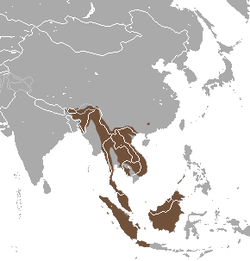
Range

Southeast Asia, rarely on Indonesian islands

Habitat

Terrestrial, tropical, forest, rainforest

Predators

Tigers, dholes, humans

Diet

Omnivore (frugivore)


Wild- Birds, mammals, fish, eggs, carrion, insects, leaves, fruit

Professional Care- Fruits, vegetables, rodents, eggs

Life Expectancy

Wild- 6 - 18 years

Professional Care- 25 years


Physical Characteristics:

Weight: 20 - 45 lbs (10 - 20 kg)

Size: 20 - 35 in (60 - 95 cm)


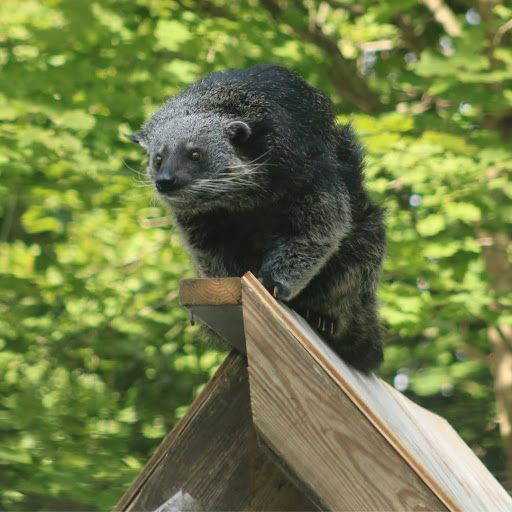
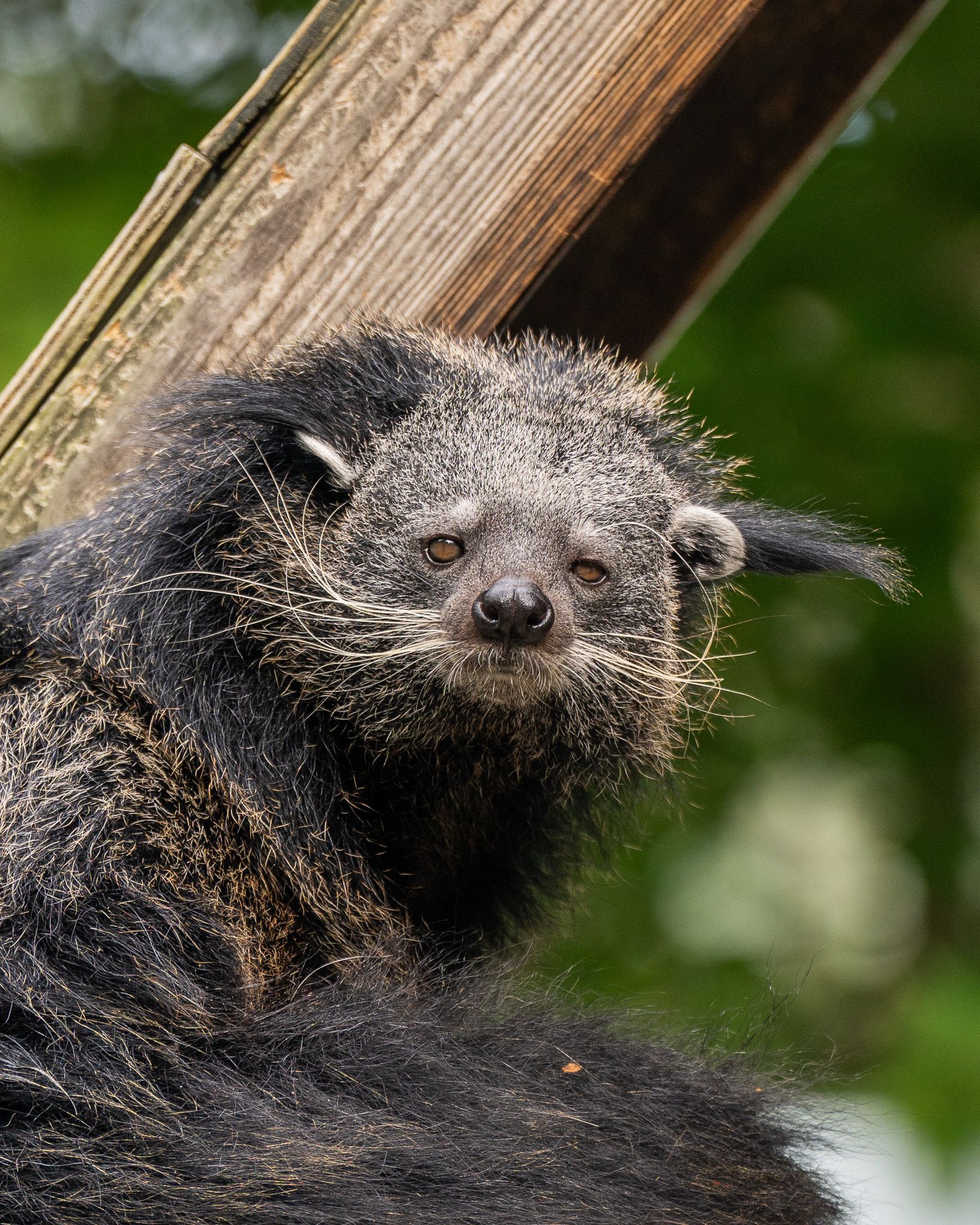
Distinguishing Characteristics:  Females are 20% larger than males. Long, coarse, black fur covers their bodies and sometimes has gray tips. Their faces have slightly lighter fur and white whiskers. Long ear tufts protrude from small rounded ears. Their eyes are small and reddish brown. Binturongs are one of only two carnivorous species that have a prehensile tail (the other being the kinkajou). Their third and fourth digits are syndactylous, meaning those fingers are fused together. 

Adaptations & Fun Facts:

Binturongs are also known as bearcats and are the mascot of Binghamton University.


Binturongs have an important job in the forests where they are found: through their fecal deposits, they spread seeds from the fruits they eat, helping to replant the rainforest. They also help with pest control because they catch and eat rodents. 


The female binturong is one of only a few mammals that can experience delayed egg implantation, which allows the female to time the birth of her young with good environmental conditions.


Binturongs have a very distinctive smell of buttered popcorn! When you visit, you will be able to smell them even from a distance! While this smell might be pleasing for humans, the scent tells other binturongs that they are trespassing on someone else’s territory. This smell can also discourage potential predators. The scent is made by an oil gland under the tail. So, if you see one of our binturongs dragging their tail, that’s the animal marking their territory!


Binturongs are primarily arboreal, meaning they mostly live and move around in the trees. But sometimes a binturong will go to the ground, usually to go up into another tree. 


Because binturongs are arboreal, they have a rare adaptation called a prehensile tail. This tail acts like another limb by grasping branches as the binturong moves through the tree.

Conservation Story

Historically, the binturong was often thought to be relatively common within its distribution range, but it is now mostly uncommon or rare, and is likely to be approaching national extinction in some range countries in southeast Asia and in China. Habitat loss and degradation are major threats to the binturong, particularly in those parts of their range where hunting occurs often. Throughout this species' range, there has been loss and degradation of forests through logging and converting forests to non-forest land; even protected areas are not exempt from deforestation. Binturongs also are threatened by being hunted for its meat, traditional medicines, skins, and captured to be sold as a pet. These animals are also farmed for their feces, which is used in the production of coffee. 


Legal conservation efforts include particular conservation actions taken by organizations which make government policy to protect all species on earth. The International Union for Conservation of Nature (IUCN) Red List Status is a critical indicator of the health of the world’s biodiversity. Binturongs are listed as "Vulnerable," which means the species is considered to be at high risk of unnatural extinction if humans do not intervene. The Indian Wild Life (Protection) Act of 1972 lists binturongs as a Schedule 1 species; this provides absolute protection to the species. In China, Binturongs are listed as Critically Endangered. The species is completely protected in Bangladesh, and partially in Thailand, Malaysia, Vietnam and Indonesia. Binturongs have no protection in Brunei.

What Can We Do To Help?

Support conservation organizations - like the Arctictis Binturong Conservation (ABConservation) and Ross Park Zoo - through volunteering, donation, and/or sponsorship. 

Check out other animals at the zoo!